

SendGrid email API alternative
Feeling dev bottlenecks with SendGrid? Use Waypoint for a new approach to divide and conquer the workload.
In this article, we’re comparing Waypoint vs SendGrid email API platforms.
High level comparison
Section titled “High level comparison”Both platforms are solid options for reliable email delivery at scale — they just take different approaches and prioritize different things.
Worth flagging up front: SendGrid sells two products on separate pricing plans — an email API for transactional emails, and marketing software for email blasts. This comparison only covers SendGrid’s email API, since Waypoint is intentionally focused on transactional emails.
SendGrid is the juggernaut in the email API space. It’s a popular and well established email delivery service that has been around since 2009.
Waypoint is the upstart in the space with similar email API offerings but with new approaches to collaboration and observability.
Why software teams choose Waypoint over SendGrid
Section titled “Why software teams choose Waypoint over SendGrid”1. A more capable dynamic template builder
Section titled “1. A more capable dynamic template builder”SendGrid has a dynamic template builder, but it tends to fall flat on data-rich transactional emails. SendGrid (like other marketing tools) reuses its marketing template builder, which assumes little to no dynamic data.
Waypoint is built specifically for data-rich transactional emails. The block-based template builder handles liquid templating, conditional hiding, loops, test data scenarios, reusable layouts, and more — all visually, no code required. The result is a much more WYSIWYG experience:
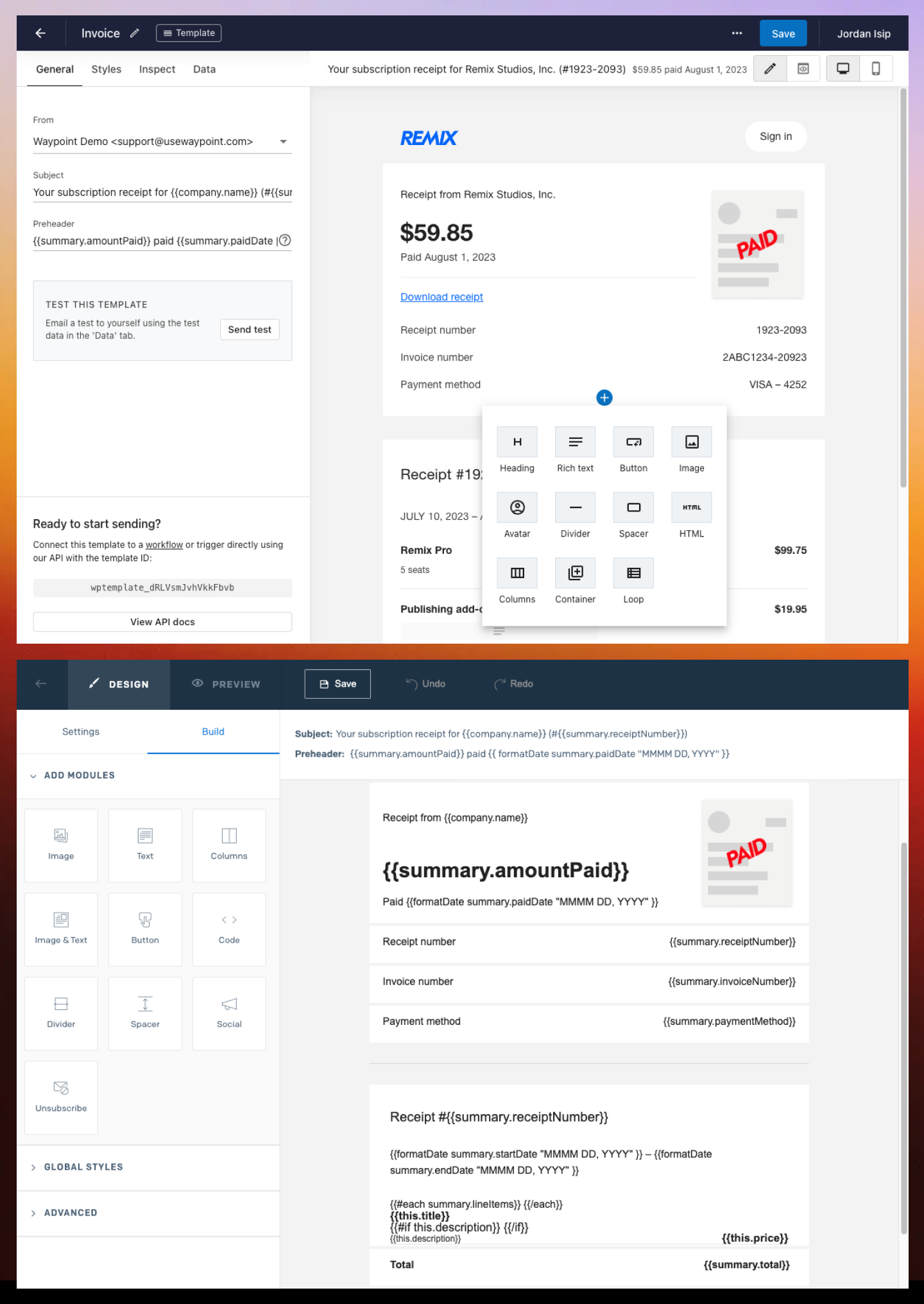
The gap widens as templates get more advanced. In the example below, Waypoint lets you build loops and conditionals visually, while SendGrid requires Handlebars and raw HTML.

2. High deliverability, even on lower paid tiers
Section titled “2. High deliverability, even on lower paid tiers”SendGrid (like most email API platforms) puts free and lower-tier accounts on shared IP pools. If a spammer joins a free plan, they can drag down the reputation of everyone else on that pool — IPs get blacklisted, and your emails start landing in spam instead of inboxes.
Waypoint doesn’t offer a free plan at all. That curation keeps deliverability high even on the lowest starter plan.
3. Less expensive at scale
Section titled “3. Less expensive at scale”Waypoint has simple, straightforward pricing. At low volumes it’s roughly on par with SendGrid; at higher volumes it’s cheaper. A few snapshots (at the time of publishing):
| Emails per month | Waypoint | SendGrid email API |
|---|---|---|
| 10,000 | $20 | $19.95 |
| 300,000 | $250 | $249 |
| 1,000,000 | $437 | $602 |
Per-month price comparison
4. Less expensive for teams
Section titled “4. Less expensive for teams”The moment you add a second teammate, SendGrid bumps you to their Pro plan at $89.95/mo. Waypoint is built for collaboration — invite as many teammates as you want, even on the starter plan.
| Teammates | Waypoint | SendGrid email API |
|---|---|---|
| 1 | $20 | $19.95 |
| 2-1000 | $20 | $89.95 |
| 1000+ | $20 | Custom |
5. Better logs
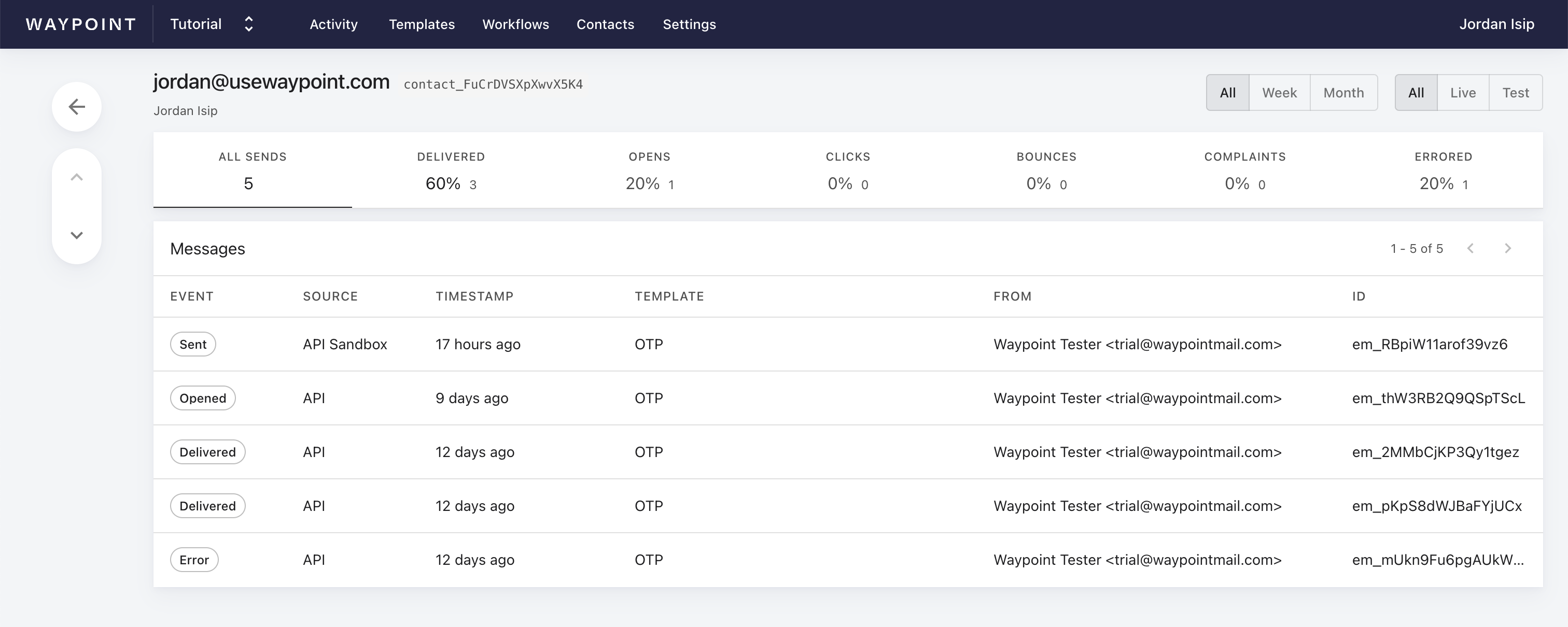
Section titled “5. Better logs”Observability is one of the biggest gaps between the two. On most platforms, transactional emails are an afterthought. Waypoint keeps a full log of every email — content, raw HTML, template data, metadata, and the event timeline. SendGrid only stores metadata and the event timeline (see below). The extra detail is invaluable for debugging and monitoring.

Waypoint also lets you drill into logs by contact for a full per-person timeline — something SendGrid doesn’t offer.
6. Real human support
Section titled “6. Real human support”Reach out and you’ll usually end up talking to one of our founders. Direct, human support is standard for every customer. On SendGrid, a dedicated account manager runs thousands of dollars a month.
Why teams might consider SendGrid over Waypoint
Section titled “Why teams might consider SendGrid over Waypoint”With all that said, why pick SendGrid? Its main edge is maturity — it’s been evolving for over a decade.
That means SendGrid has features Waypoint doesn’t, and depending on your team, some of these may be dealbreakers:
Webhooks(added Nov 2024)- Inbound email parsing
- Email rendering testing across clients
- Sub user management (credit limits on users)
- Advanced contact segmentation
- SMTP relays
- Single Sign On (SSO)
A lot of these are on Waypoint’s roadmap, and we’re building fast.
Conclusion
Section titled “Conclusion”The best way to decide is to try both. There’s plenty of overlap, but each platform has its own personality and priorities.
We’re biased, but we think you’ll love Waypoint for transactional emails — especially with a growing team. Our customers seem to agree:
“Waypoint team and support surpassed our expectations, ensuring a seamless transition from SendGrid. Their liquid templating simplified the conversion of our existing emails, and since migrating, their service has been flawless. Our emails no longer end up in spam folders, leading to an impressive increase in our onboarding conversion rates. Waypoint’s fast and reliable deliverability has taken our account verification success from below 50% to nearly 100%.”
– Dallin Dyer (CTO of Dree.com)